
Operational Safety Leadership
When Pressure Increases, Leadership Execution Determines Whether Safety Systems Hold
Most organisations have procedures, risk assessments and controls.
The real question is whether those systems still work when conditions change and decisions are made in real time.
Operational Safety Leadership focuses on the space between what is written down and what actually happens in the field.
What is Operational Safety Leadership?
Operational Safety Leadership is the practical application of leadership, communication, decision-making and operational control that helps people work safely and effectively under real operating conditions.
It is not another paperwork exercise.
It is not generic safety training.
It is how leaders, teams and systems hold together when work changes, pressure increases and decisions need to be made before every detail is clear.
Documentation Does Not Fail First. Leadership Execution Does.
Why This Matters
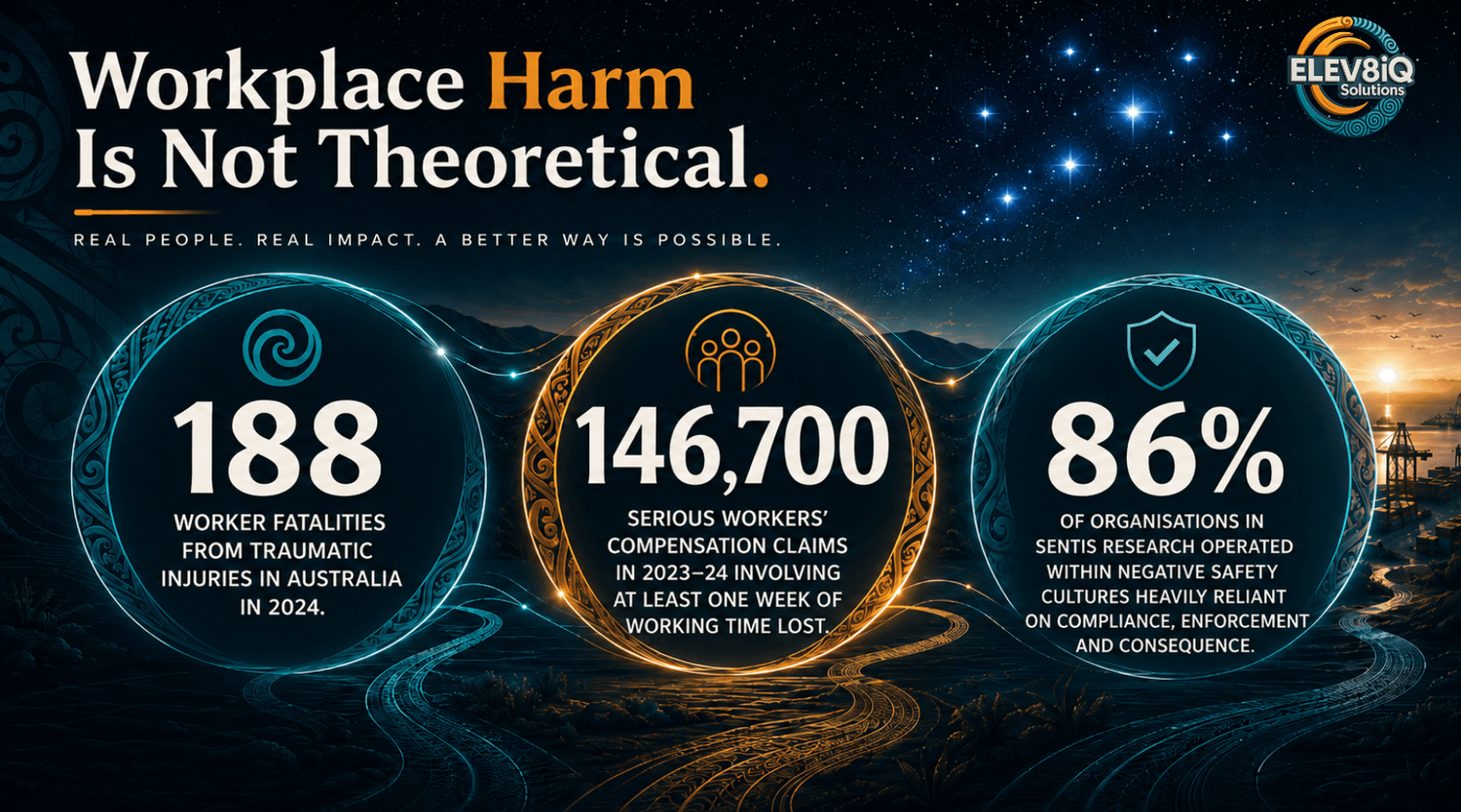
Workplace Harm Is Not Theoretical.
Behind every statistic is a person, a family, a team and a business carrying the consequences.
The leadership question is not only: Do we have safety systems?
The better question is: Do our systems hold when work gets real?
188 - Worker fatalities from traumatic injuries in Australia in 2024
146,700 — Serious workers’ compensation claims in 2023–24 involving at least one week of working time lost
86% — Of organisations in Sentis research operated within negative safety cultures heavily reliant on compliance, enforcement and consequence.
$28.6 billion - Safe Work Australia reported that Australia’s economy would be $28.6 billion larger each year in the absence of work-related injuries and illnesses.
70% - Leadership matters because managers shape the conditions people work in. Gallup reports that 70% of the variance in team engagement is related to management, and engagement is linked to performance outcomes including safety.
Behind every statistic is a person, a family, a team and a business carrying the consequences.
The leadership question is not only: Do we have safety systems?
The better question is: Do our systems hold when work gets real?
The Operational Safety Leadership Model
A Practical Lens for Leadership
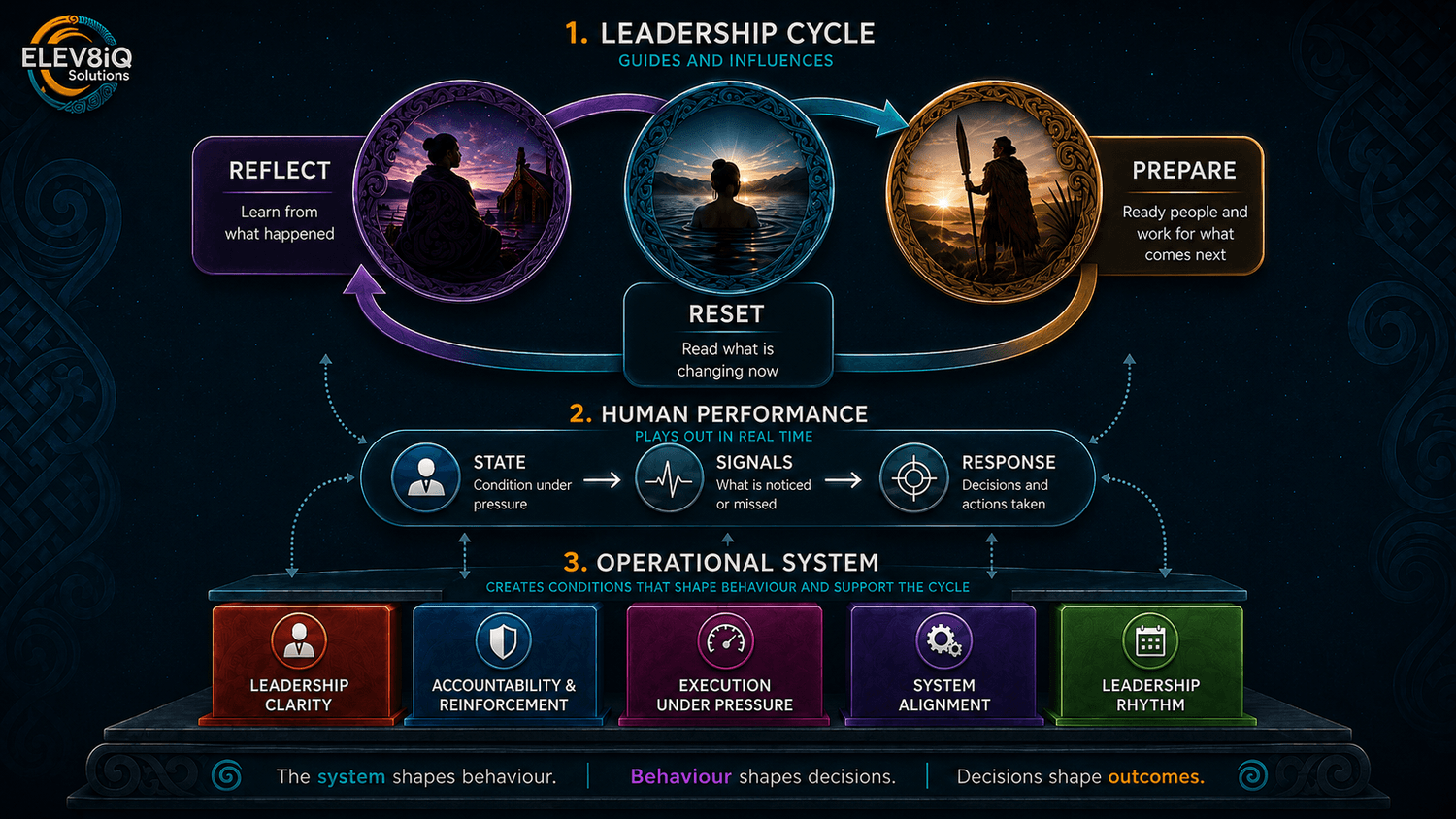
The Operational Safety Leadership Model helps leaders understand how safety performance is shaped under pressure.
It brings together three connected parts:
Human Performance: How people notice, interpret and act in real time.
The Leadership Cycle: How leaders Reflect, Reset and Prepare.
The Operational System: The pressures, routines & standards that shape how work is performed.
These parts do not operate separately.
They interact continuously.
The System Shapes Behaviour.
Behaviour Shapes Decisions.
Decisions Shape Outcomes.
How the Model Works
Part 1: Human Performance: State - Signals - Response
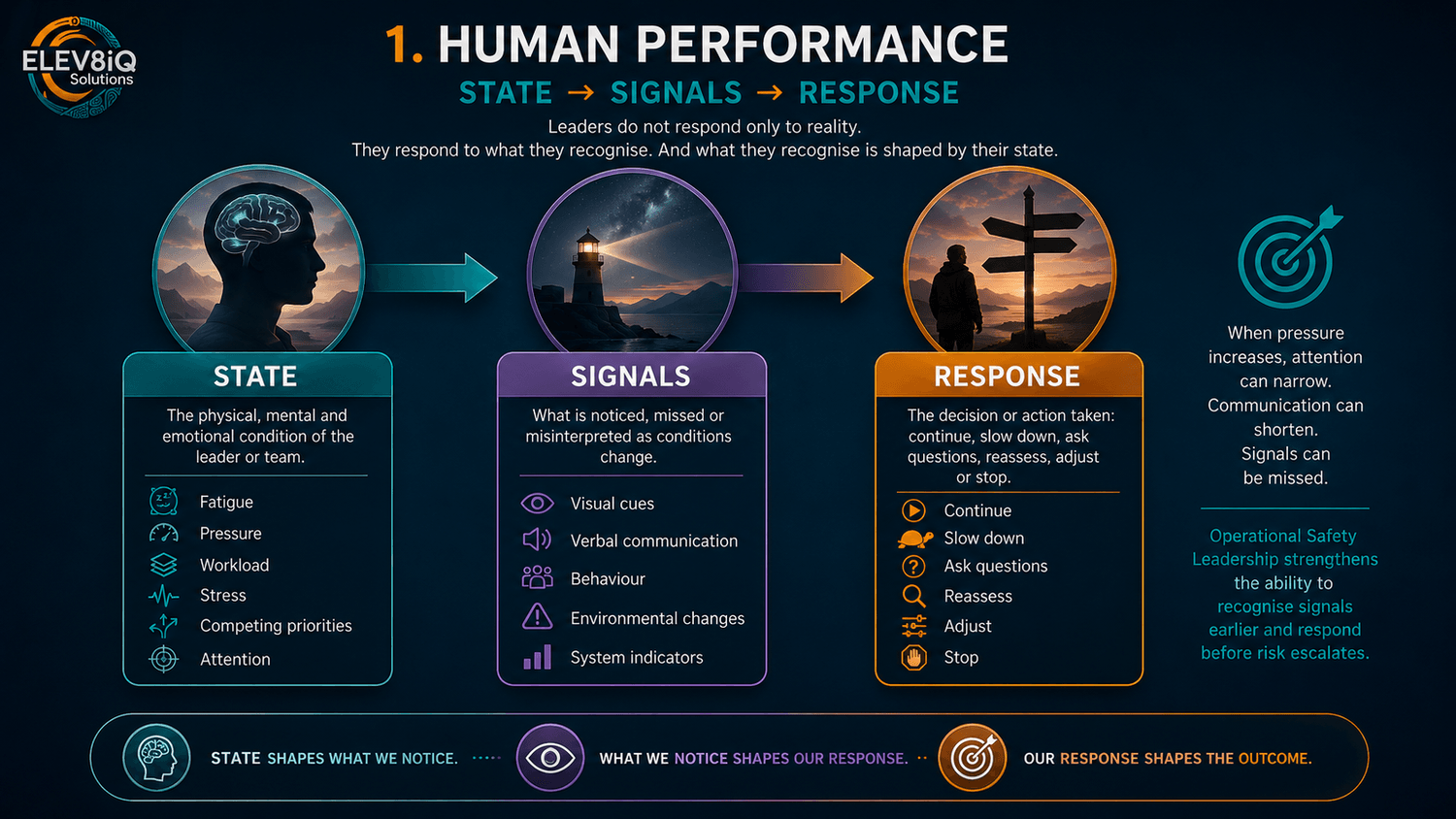
Leaders respond to what they recognise, and what they recognise is shaped by their state.
And what they recognise is shaped by their state.
Fatigue, pressure, workload, stress, competing priorities and attention can influence what a leader notices, misses or dismisses.
State: The physical, mental and emotional condition of the leader or team.
Signals: What is noticed, missed or misinterpreted as conditions change.
Response: The decision or action taken: continue, slow down, ask questions, reassess, adjust or stop.
When pressure increases, attention can narrow.
Communication can shorten.
Signals can be missed.
Operational Safety Leadership strengthens the ability to recognise signals earlier and respond before risk escalates.
Part 2: The Leadership Cycle: Reflect - Reset- Prepare

At Elev8iQ Solutions, Reflect - Reset - Prepare is inspired by Matariki, the Māori New Year in Aotearoa New Zealand, traditionally associated with reflection, renewal and preparation.
For Elev8iQ Solutions, this becomes a practical leadership rhythm.
In high-risk work, leaders are constantly navigating changing conditions.
-Pressure increases.
-Priorities compete.
-Signals are missed.
Decisions made earlier may no longer fit the reality of the work.
Reflect on how risk develops and what can be learned.
Reset attention, expectations and decisions with current conditions.
Prepare teams with the capability and confidence to respond before pressure exposes the gaps.
This is not symbolic.
It is a leadership discipline.
Part 3: The Operational System: The Five Pillars
The Operational System is where work actually happens.
It includes workload, time pressure, competing priorities, planning, supervision, communication standards, accountability and the way procedures are applied in practice.
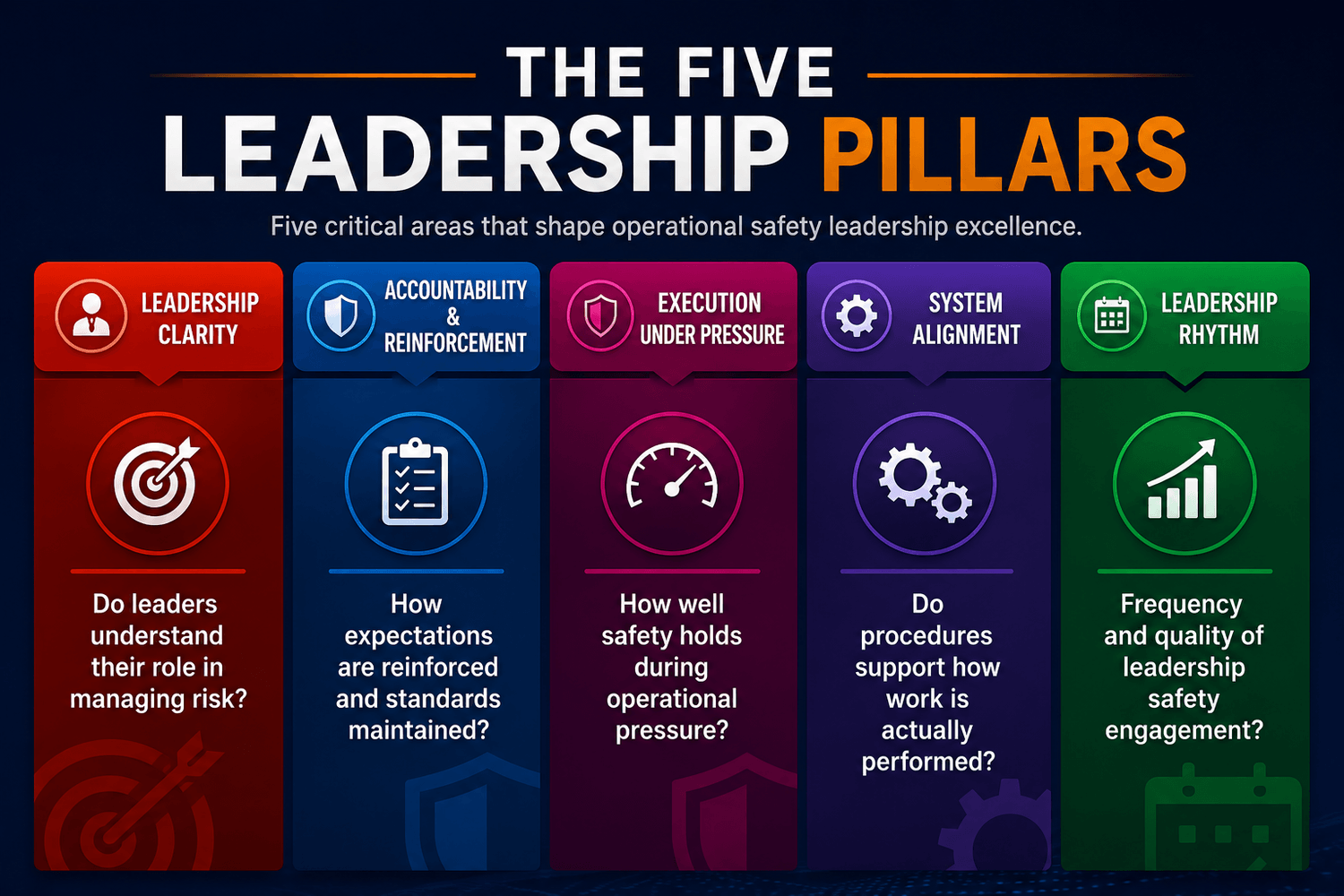
At the centre of the model are five pillars that shape whether safety systems hold in real conditions.
1. Leadership Clarity: Do leaders understand their role in managing risk?
2. Accountability & Reinforcement: How are expectations reinforced and standards maintained?
3. Execution Under Pressure: How well does safety hold when operational pressure increases?
4. System Alignment: Do procedures, controls and systems support how work is actually performed?
5. Leadership Rhythm: How often and how well do leaders actively engage with safety in practice?
When these pillars are strong, leadership execution is clearer, decisions are more consistent and safety systems are more likely to hold in practice.
When they weaken, operational drift becomes harder to see and risk can build quietly in the background.
When the Model Weakens
Risk Rarely Appears All At Once
It usually develops through familiar work, small adjustments and changing conditions that are not recognised early enough.
The task feels normal. The team has done it before. A shortcut appears practical.
The work continues without incident.
The new way becomes accepted.
This is how Complacency and Operational Drift begin.
Familiarity can reduce vigilance. Pressure can narrow attention. Compliance can create confidence that the system is still working, even when real work has started to shift.
The danger is that nothing looks broken at first.
Work still gets done.
But the system may already be moving away from the way it was designed to operate.
Operational Safety Leadership helps leaders recognise that shift earlier.
The Three Patterns Leaders Need to Recognise
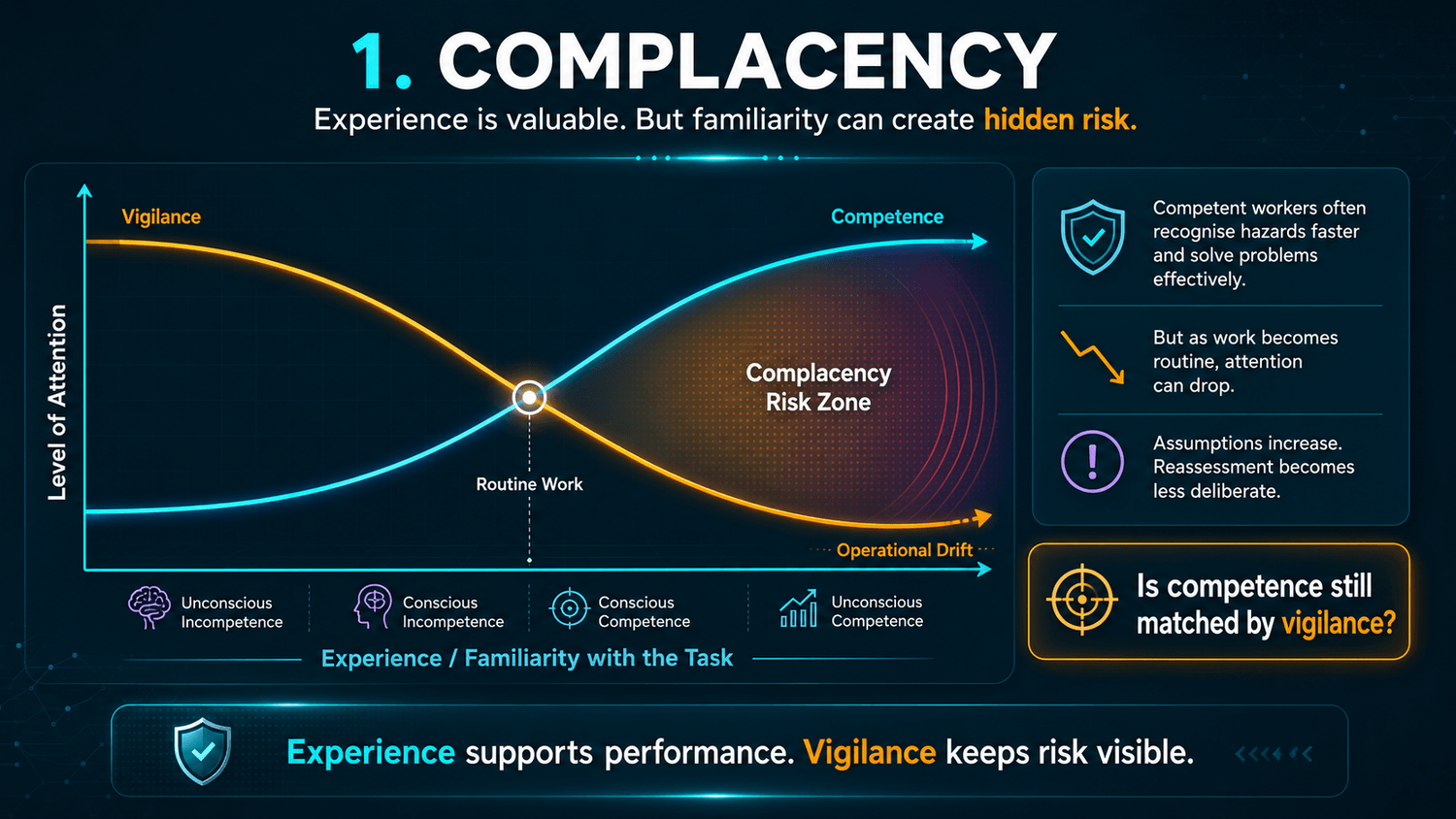
#1: Complacency
Experience is valuable.
Competent workers often recognise hazards faster, solve problems more effectively and keep work moving safely.
But familiarity can also create hidden risk.
As work becomes routine, attention can drop. Assumptions increase. Reassessment becomes less deliberate.
The question is not whether people are competent.
The question is: Is competence still matched by vigilance?
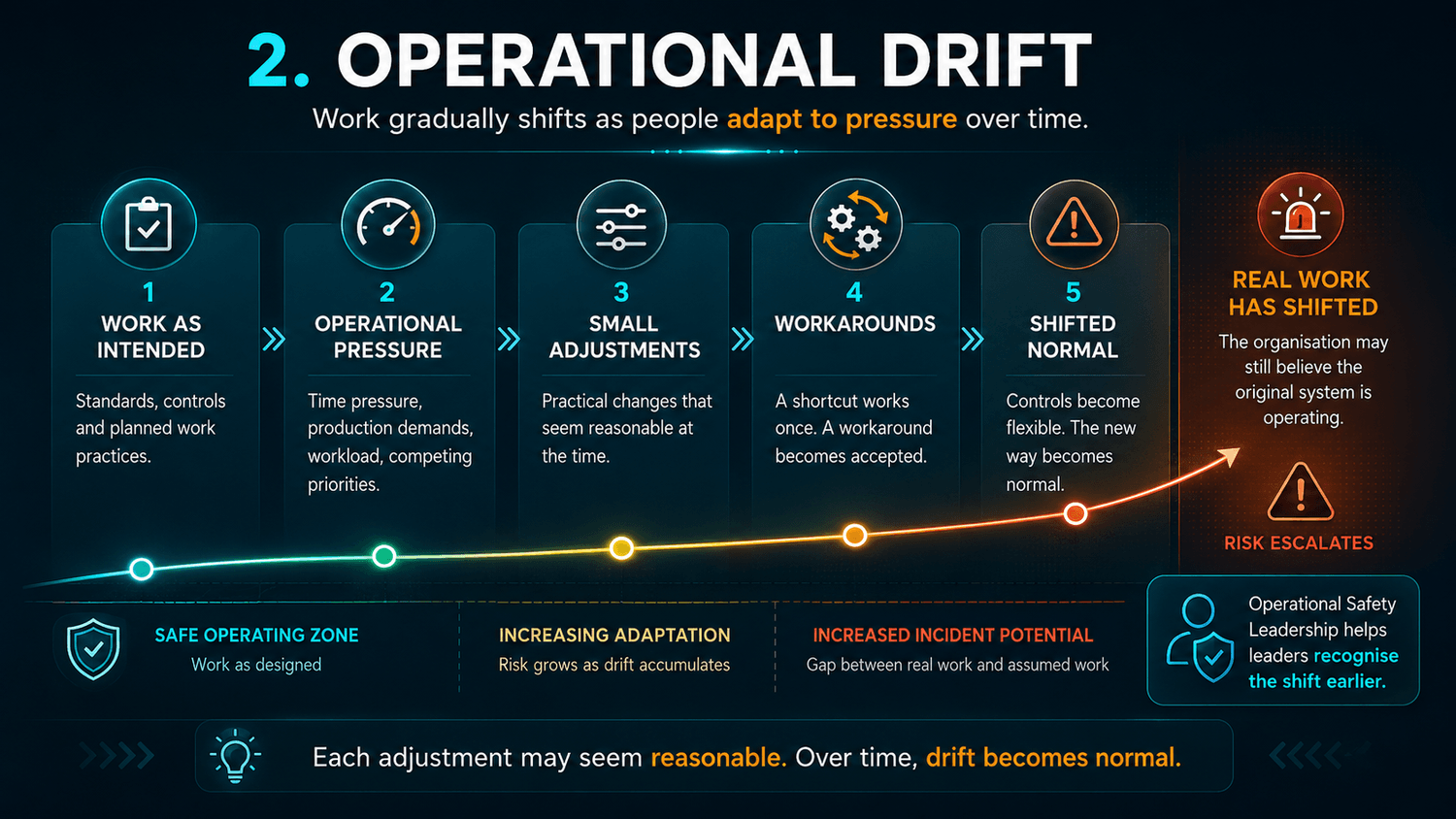
#2: Operational Drift
Operational Drift happens when work gradually moves away from intended standards, controls or work practices as people adapt to operational pressure over time.
It usually develops through small adjustments that appear practical at the time.
A shortcut works once.
A workaround becomes accepted.
A control is treated as flexible.
A new way becomes normal.
The danger is that the organisation may still believe the original system is operating, while the real work has shifted.
Operational Safety Leadership helps leaders recognise that shift earlier.
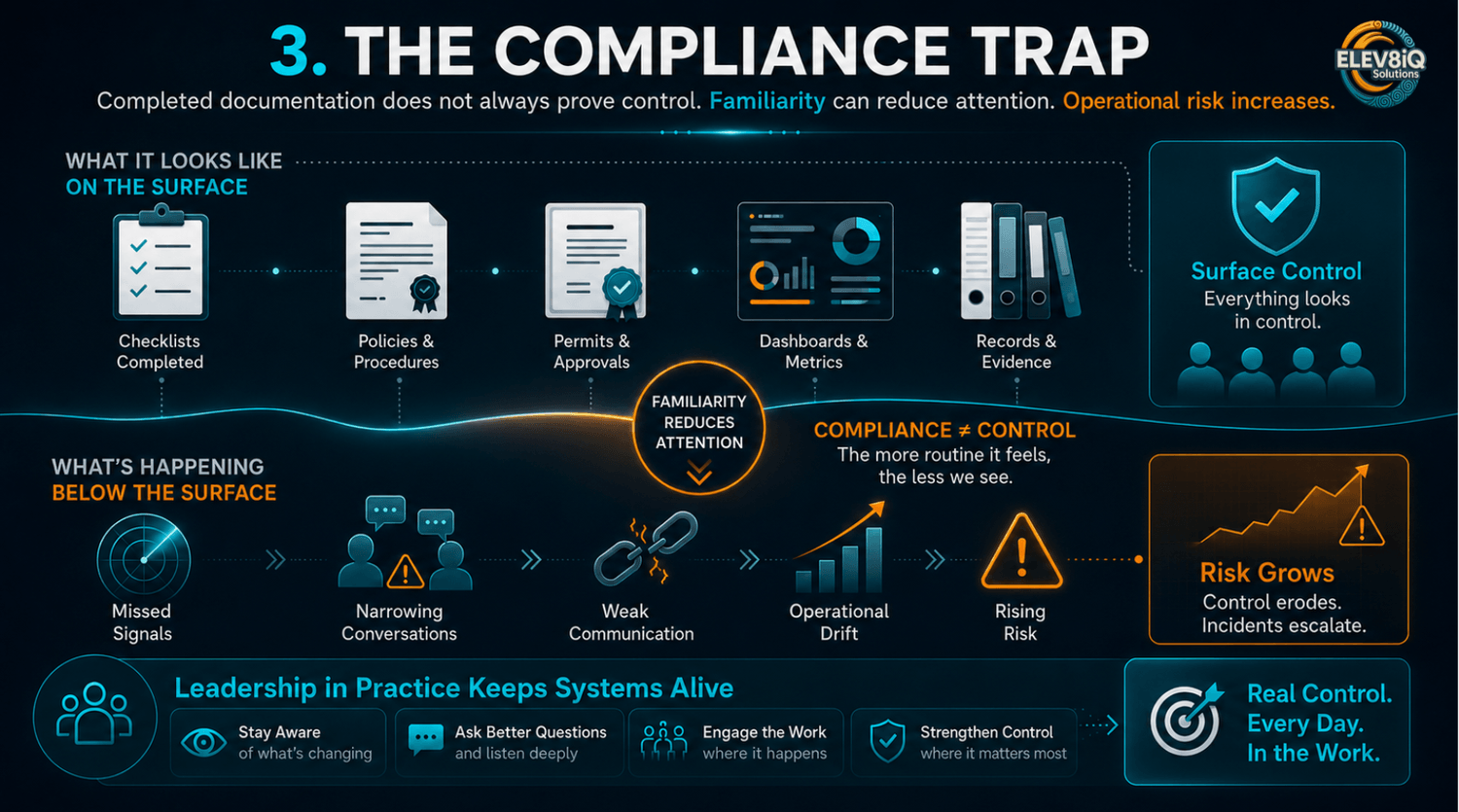
#3: The Compliance Trap
Compliance matters.
But completed documentation does not always prove control.
The Compliance Trap happens when organisations rely on systems, rules and records while missing what is changing in the work itself.
In these environments, safety can look controlled on the surface.
But reporting may reduce. Conversations may narrow. Critical signals may be missed.
Work may continue, even though the conditions have changed.
The issue Is Not If Systems Exist.
The Issue Is Whether Leadership Keeps The Systems Alive in Practice?
What the Model Helps Leaders See
The Operational Safety Leadership Model is not about adding complexity.
It is about making the hidden parts of safety performance easier to see.
It helps leaders ask better questions, like:
Are our systems still aligned with real work?
Are our leaders noticing the right signals?
Are people confident to speak up when something changes?
Are expectations reinforced consistently?
Are we learning before failure, or only after it?
These questions matter because operational safety is not sustained by documents alone.
It is sustained by leadership attention, communication, decision-making and action in everyday moments.
Where To Start
This page introduces the model.
It does not teach the full application.
The deeper work sits inside the Elev8iQ resources and learning pathway.
Start with awareness.
If this page has helped you recognise gaps between what is written down and what happens in the field, the next step is to explore the resources.